French Tolls Guide planning starts the moment we roll off the ferry at Calais or leave the Eurotunnel at Coquelles. The air feels different, and the road signs switch to that familiar blue and white. Straight away, the adventure properly begins. However, for many UK caravanners, that first burst of excitement can quickly turn into toll anxiety. Navigating the French motorway system, known as the péage, can feel awkward when you have several metres of caravan behind you. In this French Tolls Guide, we are sharing the tips that have helped us feel more relaxed on French motorways. We have spent many summers touring France. From Brittany to the Dordogne, we have learned that a useful French Tolls Guide comes down to preparation and one or two bits of handy tech.
French Tolls Guide: Class 1 or Class 2?
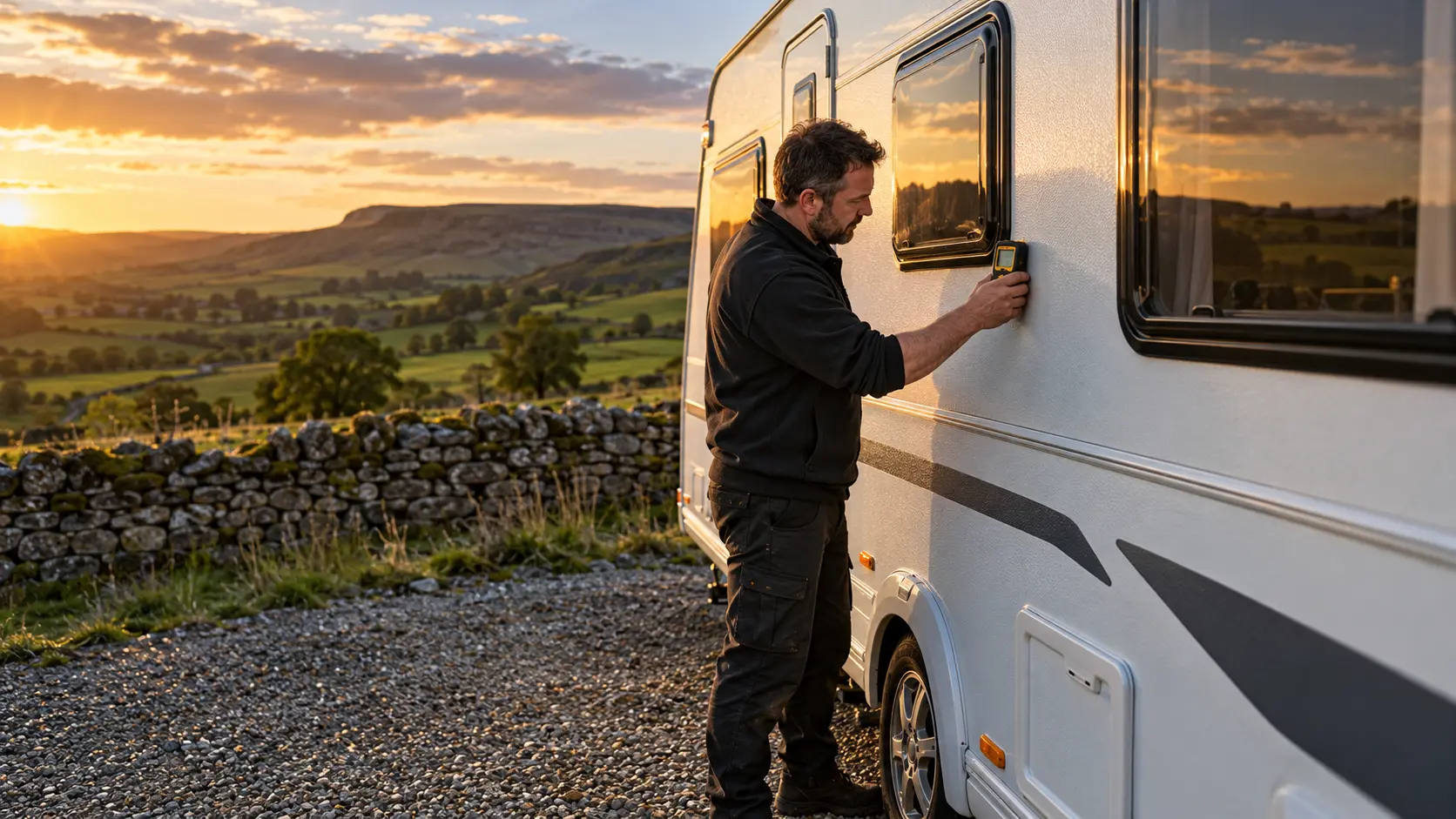
One of the most common questions we get asked is about the vehicle classification system. When you are towing, the price you pay depends on the height and weight of your setup. Most standard cars fall into Class 1, but once you hitch up the caravan, things change. Generally, if your caravan height is between 2 and 3 meters and your total weight (GVW) is under 3.5 tonnes, you will be charged as Class 2. This is slightly more expensive than a solo car, but it is the standard for almost every UK caravan we see on the road.
We remember our first trip. We nervously watched the overhead height sensors and wondered if our roof-mounted aerial would trigger a higher-tier charge. Fortunately, the systems are quite accurate. If you ever get charged as Class 3 by mistake, there is usually a “help” button on the machine. That class is for heavy goods vehicles or very large motorhomes. It is important to check the screen before you tap your card. We once had a sensor misread our setup on a rainy day in Rouen. A quick press of the intercom and a polite “Caravane, s’il vous plaît” brought the price back down to Class 2.
Using a Tag: French Tolls Guide
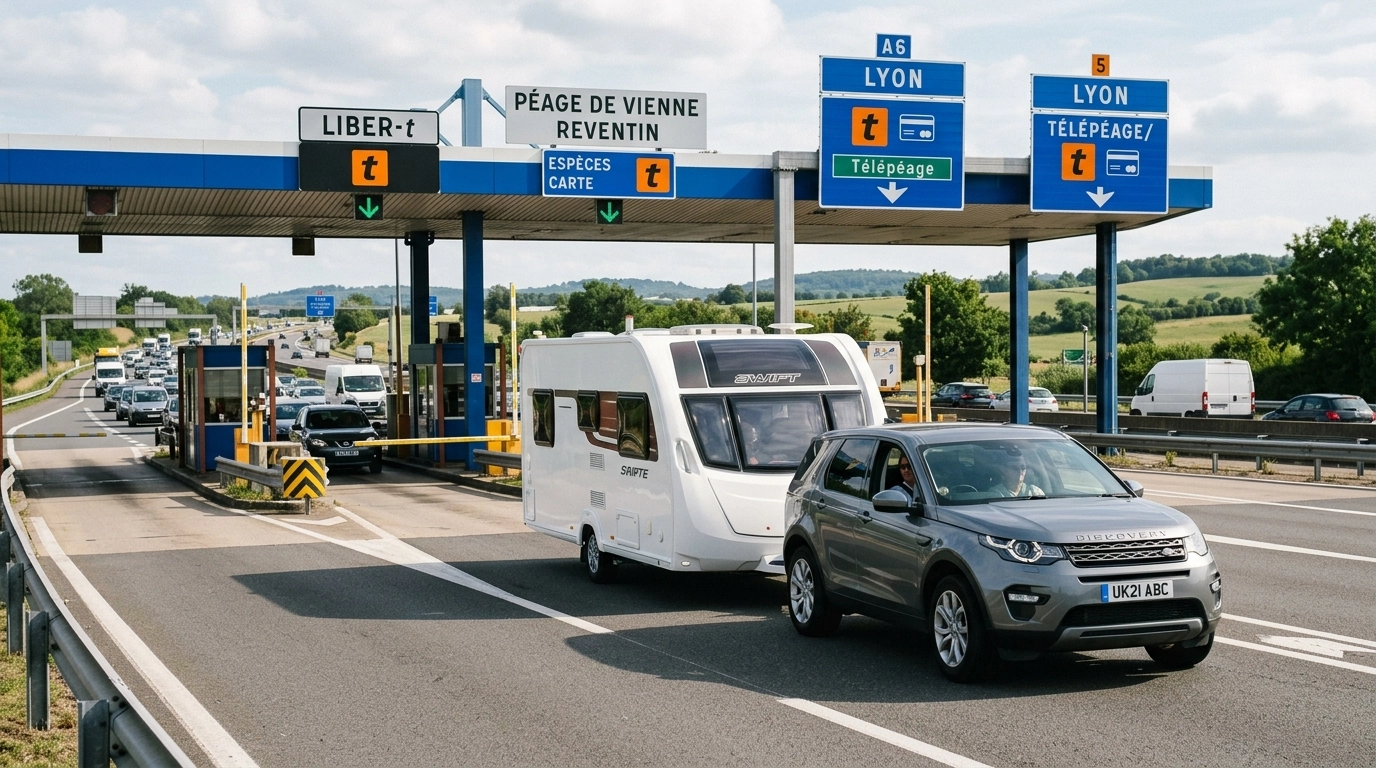
If you want to simplify the drive, we cannot recommend a Liber-t tag enough. We use and recommend Emovis, and we always use it for our trips through France. These small devices, often provided by companies like Emovis or Fulli, stick to your windscreen behind the rearview mirror. As you approach the toll booth, look for the lanes marked with a large orange “t” symbol. Instead of stopping and stretching for the machine, you simply slow down to 30km/h, or stop briefly depending on the lane. Then you hear the beep, the barrier lifts, and you carry on. For us, that is one of the most useful parts of any French Tolls Guide.
Using a tag has completely transformed our travel days. There is nothing quite like bypassing a long queue during the August rush. Then we roll straight through the dedicated “t” lanes. It also solves the reach problem. If you are driving a right-hand drive car without a passenger, the toll machine can be a stretch. With the tag, you do not even need to open the window. That alone makes this French Tolls Guide worth keeping in mind before a long towing day.

French Tolls Guide Tips for the Toll Booth Dance
Navigating the actual toll plaza, or gare de péage, can feel daunting when it is busy. As you approach, you will see several symbols above the lanes. A green arrow means the lane is open to everyone, while the orange “t” is for tag holders. Some lanes are “t” only, and others take cards as well. If you are towing a caravan, avoid lanes with a height-restricted hanging bar. These are usually marked with a “2.0m” sign and are meant for cars. We nearly always aim for the far-right lanes because they are usually wider and better suited to larger outfits. That simple habit has saved us plenty of stress, and it fits neatly into any practical French Tolls Guide.
We have found that having a dedicated toll assistant, usually the passenger, is a lifesaver. Their job is simple: keep the payment card or ticket ready if we are not using the tag. If you are travelling solo, many caravanners swear by a long-handled grabber for passing tickets and cards to the machine. It may look a bit silly, but it beats climbing out of the car while a queue builds behind you.

French Tolls Guide for Free-Flow Roads
Recently, France has started introducing “flux libre”, or free-flow motorways. These are sections of road with no physical barriers or toll booths at all. Instead, overhead cameras scan your number plate or tag while you drive at full motorway speed. The A79 in central France and parts of the A13 and A14 between Paris and Normandy now use this system. Because of that, a current French Tolls Guide is more useful than ever.
If you have a Liber-t tag, you do not need to do anything. The system will detect your tag and bill your account as usual. However, if you do not have a tag, you must pay online or at a physical payment terminal within 72 hours. You will often find those terminals at service stations on the route. We have heard plenty of stories about people forgetting and getting a hefty fine later. That is why any French Tolls Guide should mention checking your route in advance on sites like Sanef or Alis before you travel.

The Great Ticket Quest
On the motorways that aren’t “open” (where you pay a flat fee at certain points), you will encounter the “closed” system. This involves taking a ticket at the start of your journey and paying when you exit or when the motorway system changes operators. We cannot stress this enough: keep that ticket safe!
Without a ticket, the machine will usually charge the maximum possible fee for that motorway stretch. That can be quite a shock to the holiday budget. It is worth keeping the ticket somewhere easy to grab. That way, you are not rummaging around at the exit booth when you would rather be getting on with the drive.
Is the Péage Always the Best Choice?
For us, the answer is yes. We never take the scenic route when we are towing, and we only use the toll motorways because we prefer the speed, convenience, and smoother overall journey. When we have the caravan behind us, we want the most direct route possible, with fewer villages, fewer roundabouts, and far less stop-start driving. That was exactly how we travelled when we headed to the South of France last summer, because getting down there efficiently mattered more to us than taking slower back-road detours. If you want a real example of that kind of trip, have a look at our review of this stay in the South of France.
A typical rule of thumb for budgeting is to expect roughly €1 for every 10 miles of toll road. On a long run from Calais to the Mediterranean, the cost can add up quickly, and it can easily pass €100 each way for a car and caravan. Even so, we still choose the péage every time. For us, the extra cost is worth it for the easier towing experience, the better road surfaces, and the simple fact that we can cover big distances with much less stress.
The Joy of the French Aire
One of the greatest rewards of using the French toll roads is the access to the aires. These rest areas range from simple picnic spots with toilets, known as aires de repos, to larger service stations with shops, restaurants, and fuel. We have found that the French really understand the needs of the long-distance traveller, especially those of us with caravans in tow.
Most major service areas have large, clearly marked pull-through bays for “poids lourds” and “caravanes.” Consequently, you do not need to worry about reversing into a tight space after a long stint behind the wheel. We often plan our stops around the larger aires. Some even have woodland walks, play areas, and outdoor fitness equipment. Taking twenty minutes to stretch your legs and enjoy a coffee makes the miles melt away. They are also a great place to check that your Liber-t tag is still firmly attached and that your caravan’s road lights are all working. It is a small detail, but it earns its place in any well-used French Tolls Guide.
A Quick Checklist for the Road
To keep your journey as smooth as possible, we suggest a quick final check before leaving the port or tunnel. Make sure your Crit’Air sticker is displayed if you plan to pass through or near major cities like Paris or Lyon. Low-emission zones are becoming more common. Also check that your insurance and breakdown cover are valid for European travel. Keep mandatory kit, like high-visibility vests and a warning triangle, somewhere easy to reach. A French Tolls Guide can point you in the right direction, but a few checks before departure make the biggest difference.
Naturally, the cost of the tolls is an investment in a faster, smoother journey. By choosing the péage, you are paying for good tarmac, frequent services, and a more direct route south. Whether you are heading for the Alps or the beaches of the Vendée, this French Tolls Guide should make the whole system feel much more straightforward. We always look forward to that first “beep” of the tag because it feels like the holiday has properly started.
If you are planning your own cross-channel adventure, keep this French Tolls Guide handy and make the journey part of the fun. Pack the kettle, keep the snacks within reach, and settle into the rhythm of the French roads. For more inspiration on where to head after the motorways, browse our campsite reviews and travel photos in the Gallery. We are always updating it with new gems we find along the way, and this French Tolls Guide is a good place to start.
Related Guides
- French Crit’Air Guide: Everything You Need to Tour Stress-Free
- EU Entry Exit System Guide
- First Caravan Trip Checklist
- How to Choose the Right Caravan Site
- What to Pack for a Caravan Holiday
Suggest a Campsite for Review
Have you stayed at a campsite that deserves more attention?
We’re always looking for new campsites to feature on Caravan Adventuring. Whether it’s a hidden gem, a family favourite, or a site with outstanding facilities, we’d love to hear about it.