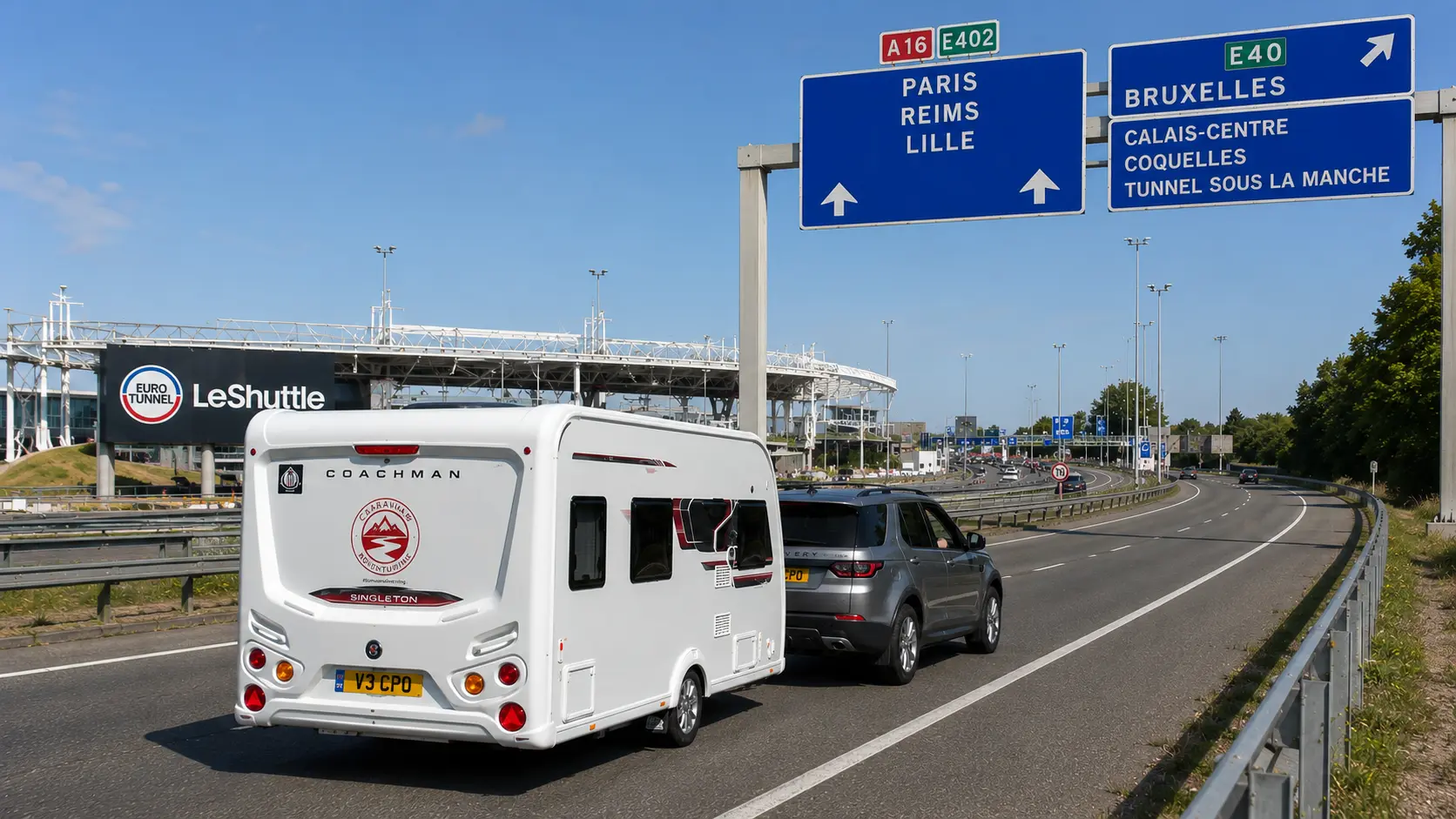
Using LeShuttle through the Channel Tunnel is one of the quickest ways to begin a European caravan or motorhome tour from the UK. Once you leave the terminal at Coquelles near Calais, however, there are several possible routes towards France, Spain, Italy and Germany.
The best route is not always the one showing the shortest journey time. When towing a caravan, it is also worth considering motorway tolls, steep gradients, busy city roads, low-emission zones, overnight stops and how comfortable the route will be with a longer touring outfit.
This guide covers the most practical routes from the Eurotunnel terminal to many of the main touring destinations in Western Europe. Distances and journey times are approximate and should always be checked against current traffic conditions, road closures and restrictions before travelling.
Contents
- Before Leaving the Eurotunnel Terminal
- Quick Route Guide
- Best Routes from Eurotunnel to France
- Best Routes from Eurotunnel to Spain
- Best Routes from Eurotunnel to Italy
- Best Routes from Eurotunnel to Germany
- Should You Avoid Paris When Towing?
- Should You Use Toll Roads or Toll-Free Routes?
- Planning Overnight Stops
- Route-Planning Tips for Caravans and Motorhomes
Before Leaving the Eurotunnel Terminal
LeShuttle arrives in Coquelles, immediately southwest of Calais. The terminal connects conveniently with the A16 and the wider French autoroute network, so you can usually begin your onward journey without driving through central Calais.
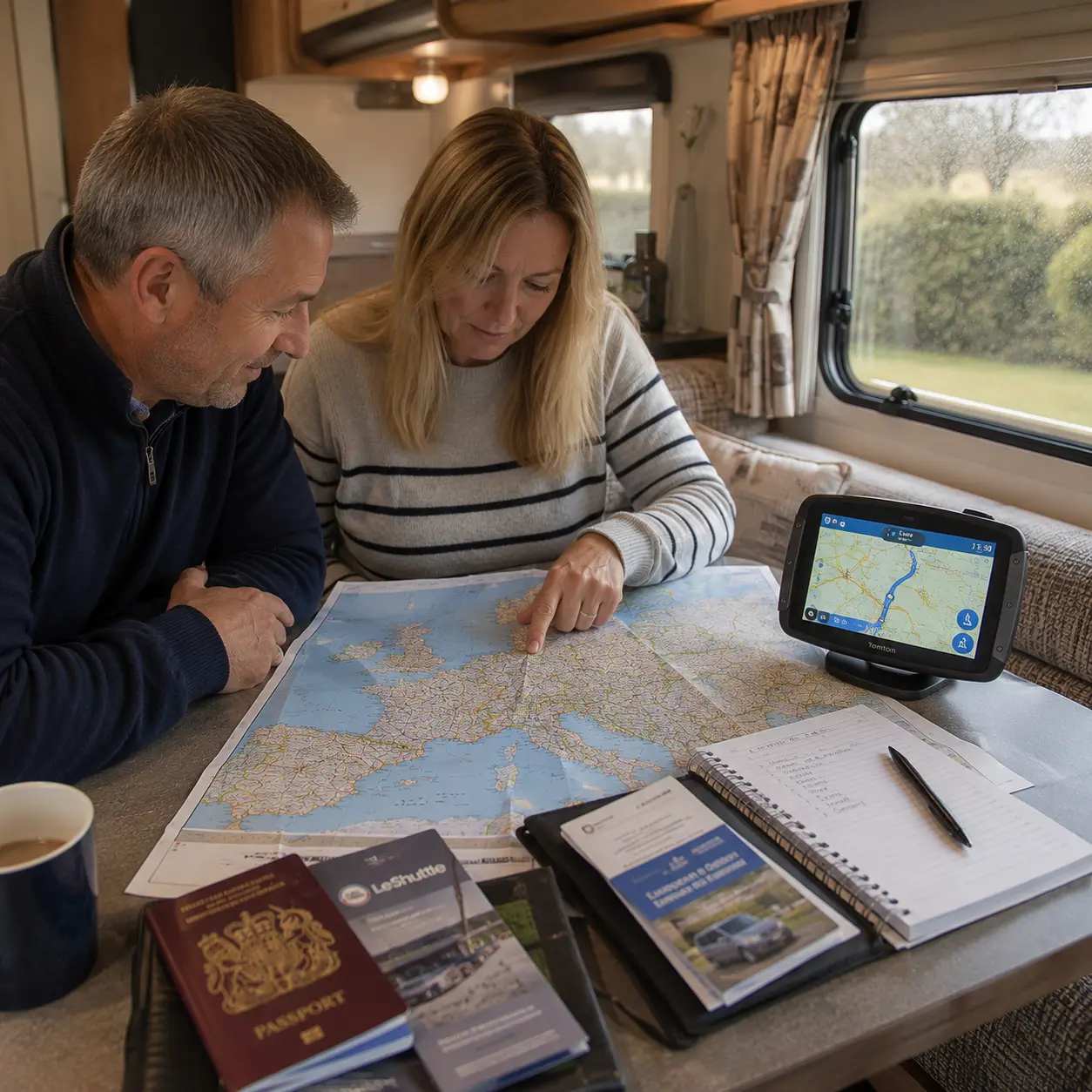
Before leaving the terminal area, check that your sat-nav is set to the correct vehicle dimensions and that it has not selected unsuitable shortcuts. Drivers towing a caravan should enter the total outfit length where possible, while motorhome owners should enter the vehicle height, width and weight.
It is also sensible to check the following before joining the motorway:
- Your headlights have been adjusted or fitted with suitable beam converters.
- Your UK identifier is displayed correctly.
- Your caravan coupling, breakaway cable and electrical connection are secure.
- Your mirrors provide the legally required field of vision.
- Your Crit’Air sticker is displayed if your route may enter a French low-emission zone.
- Your chosen fuel stops can accommodate a caravan or large motorhome.
- Your overnight stop is reachable without entering a restricted city centre.
Do not rely entirely on the route suggested automatically by your sat-nav. Standard navigation systems can prioritise small roads, narrow village streets and unsuitable city-centre diversions simply because they appear slightly shorter.
Quick Route Guide from Eurotunnel
| Destination | Typical Main Route | Main Considerations |
|---|---|---|
| Normandy | A16 towards Boulogne, Abbeville and Rouen | Generally straightforward, although Rouen requires careful route planning |
| Brittany | A16, A28, A13 and A84 | Avoid central Paris; much of Brittany has toll-free dual carriageways |
| Loire Valley | A26, A1, A3/A86 and A10 | Paris traffic and Crit’Air restrictions may affect the route |
| Dordogne | A26, A1, A3/A86, A10 and A20 | Long first day; consider an overnight stop north of Limoges |
| Bordeaux | A26, A1, A3/A86 and A10 | Fast motorway route but includes tolls and possible Paris congestion |
| Provence | A26, A5, A31, A6 and A7 | Useful Paris-avoiding route; the A7 can be extremely busy |
| Barcelona and Costa Brava | A26, A5, A31, A6, A7, A9 and AP-7 | Long-distance route with tolls in France and heavy summer traffic |
| Valencia and Costa Blanca | Via Lyon, Orange, Narbonne, Barcelona and AP-7/A-7 | Best completed over several days when towing |
| Italian Lakes | Via Reims, Metz, Strasbourg, Basel and Switzerland | Swiss motorway vignettes are required for both car and caravan |
| Turin | Via Reims, Troyes, Dijon, Lyon and the Fréjus Tunnel | Substantial toll and tunnel charges |
| Venice | Via Belgium, Luxembourg, Germany, Austria and the Brenner route | Austrian vignette and additional route tolls may apply |
| Cologne | A16, Belgium E40 and E42, then Germany A4 | One of the simplest German destinations from Calais |
| Black Forest | Via Lille, Luxembourg, Metz and Strasbourg | Check whether your destination lies inside a German environmental zone |
| Munich and Bavaria | Via Belgium, Luxembourg, Saarbrücken, Karlsruhe and Stuttgart | Busy autobahns and possible environmental zones near cities |
Best Routes from Eurotunnel to France
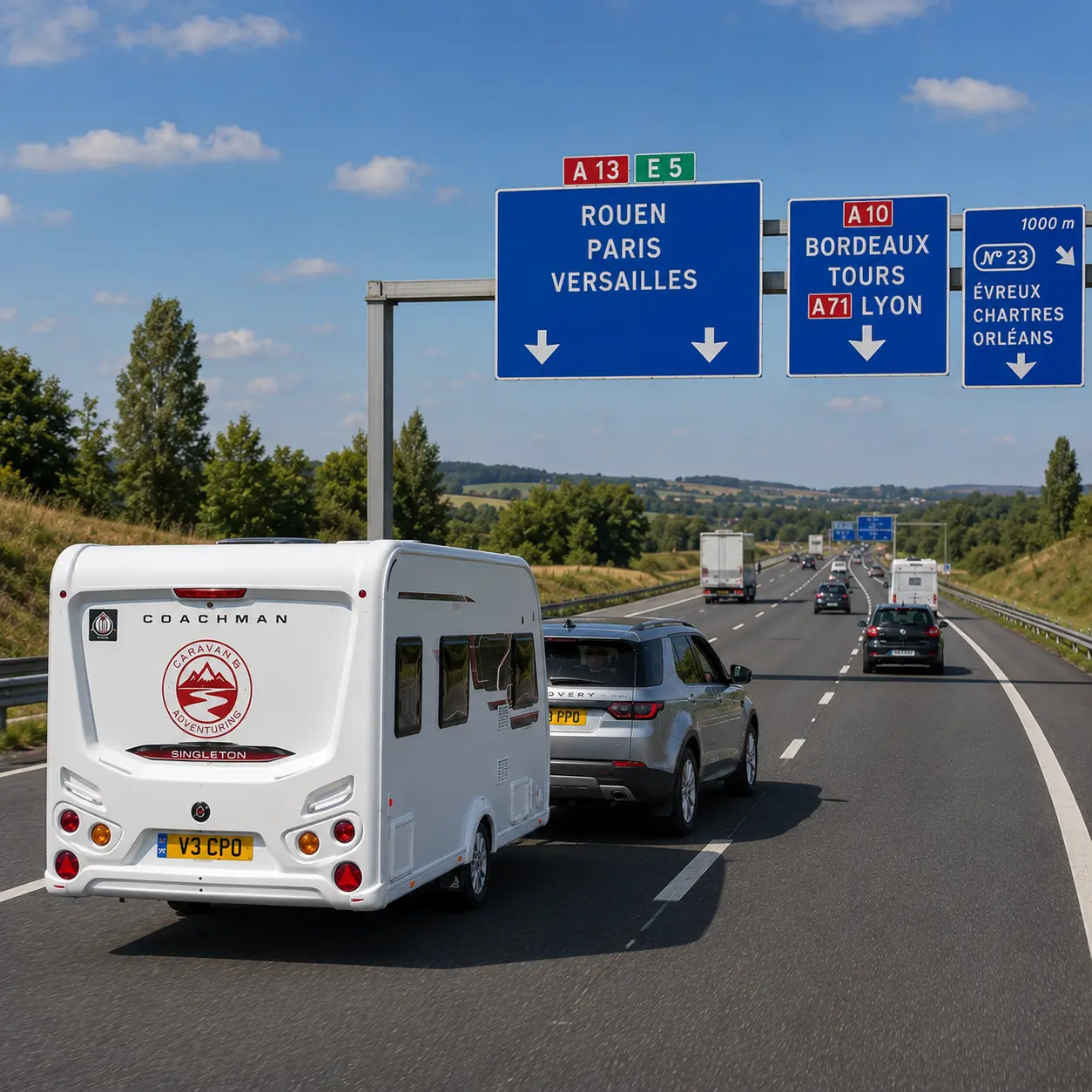
France has an extensive motorway network, making it relatively straightforward to travel from Calais towards most major touring regions. The main decision is often whether to use the fastest autoroute route, pay French motorway tolls or choose a slower route that avoids Paris and reduces costs.
Eurotunnel to Normandy
Recommended route: A16 towards Boulogne-sur-Mer and Abbeville, followed by the A28 towards Rouen.
This is generally the most practical route for destinations around Rouen, Honfleur, Deauville, Bayeux and the Normandy coast. It avoids Paris and uses major roads for most of the journey.
For western Normandy, continue from Rouen towards Caen using the A13. For the D-Day beaches and Bayeux, continue past Caen using the N13.
Best for: Rouen, Honfleur, Caen, Bayeux and the Normandy beaches.
Watch out for: Complicated junctions and traffic management around Rouen. Follow signs carefully and avoid allowing a standard sat-nav to take your caravan through central streets.
Tolls: Some sections may be tolled, particularly around major bridges and parts of the motorway network.
Rouen has historically been one of the more awkward places to cross while towing because of busy roads, bridge routes and changing traffic arrangements. Check your route shortly before travelling rather than relying on an old printed itinerary.
Eurotunnel to Brittany
Recommended route: A16 towards Abbeville, A28 towards Rouen, A13 towards Caen and A84 towards Rennes.
This route avoids Paris and is usually the most comfortable option for caravanners heading towards Rennes, Saint-Malo, Dinan, the Gulf of Morbihan or the wider Brittany peninsula.
Once you enter Brittany, many major dual carriageways are toll-free. This can make the final section of the journey noticeably cheaper than routes using long stretches of tolled autoroute elsewhere in France.
Best for: Rennes, Saint-Malo, Dinan, Vannes and southern or western Brittany.
Alternative: Some routes travel via Le Mans, but this is not normally necessary when arriving at Calais unless traffic conditions make the Normandy route unsuitable.
Suggested overnight area: Rouen, Évreux, Caen or the surrounding countryside, depending on your arrival time.
Eurotunnel to the Loire Valley
Fast route: A26 towards Arras, A1 towards Paris, A3 or A86 around Paris and A10 towards Orléans and Tours.
This is normally the quickest motorway route to Orléans, Blois, Amboise and Tours. However, it can involve heavy traffic around Paris, particularly during weekday commuting periods, weekends and the main summer holiday season.
A Paris-avoiding alternative is to travel via Rouen, Évreux, Dreux and Chartres before joining routes towards Orléans or Tours. This may be slower on paper but can provide a less stressful journey when the Paris road network is heavily congested.
Best for: Orléans, Blois, Chambord, Amboise and Tours.
Watch out for: Paris low-emission restrictions and congestion around the A86.
Suggested overnight area: Chartres, Orléans or a campsite north of the Loire Valley.
Eurotunnel to the Dordogne
Recommended route: A26, A1, A3/A86, A10 towards Orléans, followed by the A71 and A20 towards Limoges and Brive-la-Gaillarde.
The A20 is the main route towards northern and eastern parts of the Dordogne. From Brive-la-Gaillarde, your final route will depend on whether you are heading towards Sarlat-la-Canéda, Montignac, Périgueux or Bergerac.
This is a long journey from Calais and most caravanners will be more comfortable dividing it across two days. Attempting the entire journey immediately after travelling from home to Folkestone can make the final rural section tiring.
Best for: Limoges, Brive-la-Gaillarde, Sarlat, Montignac and much of the Dordogne.
Watch out for: Narrower roads during the final approach to rural campsites.
Suggested overnight area: Orléans, Vierzon, Châteauroux or north of Limoges.
Always check the final campsite approach separately. Some Dordogne campsites are reached by narrow lanes, steep entrances or village roads that are perfectly manageable with care but unsuitable for an unplanned diversion.
Eurotunnel to Bordeaux
Fast route: A26 towards Arras, A1 towards Paris, A3/A86 around Paris and A10 through Orléans, Tours and Poitiers towards Bordeaux.
This is the most direct high-speed route and is generally straightforward once you are clear of the Paris region. The main disadvantage is the cost of French motorway tolls, particularly for a car towing a caravan, which may be placed into a higher toll class than a solo car.
An alternative route avoids Paris by travelling via Rouen, Évreux, Chartres and Tours. This can reduce the stress of crossing the Paris area, although it may add distance or time depending on current traffic.
Best for: Bordeaux, the Gironde, Arcachon and onward journeys towards western Spain.
Watch out for: Heavy traffic around Tours and Bordeaux during summer weekends.
Suggested overnight area: Tours, Poitiers or Saintes.
Eurotunnel to the French Alps
Recommended Paris-avoiding route: A26 towards Reims and Troyes, A5 towards Langres, A31 towards Dijon, A6 towards Mâcon and A40 or A43 depending on your destination.
This route is useful for destinations around Annecy, Chamonix, Bourg-Saint-Maurice, Grenoble and the northern French Alps. It avoids central Paris and uses major autoroutes for most of the journey.
For Annecy and Chamonix, the A40 is often the most practical approach. For Grenoble and resorts further south, continue towards Lyon before joining the A43 or A48 as appropriate.
Best for: Annecy, Chamonix, Grenoble and Alpine touring areas.
Watch out for: Long gradients, tunnel restrictions, winter equipment rules and busy mountain approaches.
Suggested overnight area: Reims, Troyes, Langres, Dijon or Mâcon.
Do not assume that the shortest route over or through the mountains will be suitable for your outfit. Mountain passes can have seasonal closures, width restrictions or gradients that make an autoroute and tunnel route considerably safer.
Eurotunnel to Provence and the Côte d’Azur
Recommended route: A26 towards Reims and Troyes, A5 towards Langres, A31 towards Dijon, A6 towards Lyon and A7 towards Orange, Avignon and Provence.
This is the classic eastern route to southern France and avoids the need to cross Paris. It is usually the most logical option for Avignon, Arles, the Luberon, Marseille and much of Provence.
For the Côte d’Azur, continue from the A7 towards Aix-en-Provence and then use the A8 towards Cannes, Nice and the Italian border.
Best for: Avignon, Orange, Arles, Aix-en-Provence, Marseille, Cannes and Nice.
Watch out for: Severe congestion on the A7 during French holiday weekends and summer changeover days.
Suggested overnight area: Reims, Troyes, Dijon, Beaune, Mâcon or north of Lyon.
The A7 through the Rhône Valley is easy to follow but can become extremely busy. Leaving early, avoiding Saturday changeover traffic and allowing additional time can make a substantial difference.
Best Routes from Eurotunnel to Spain
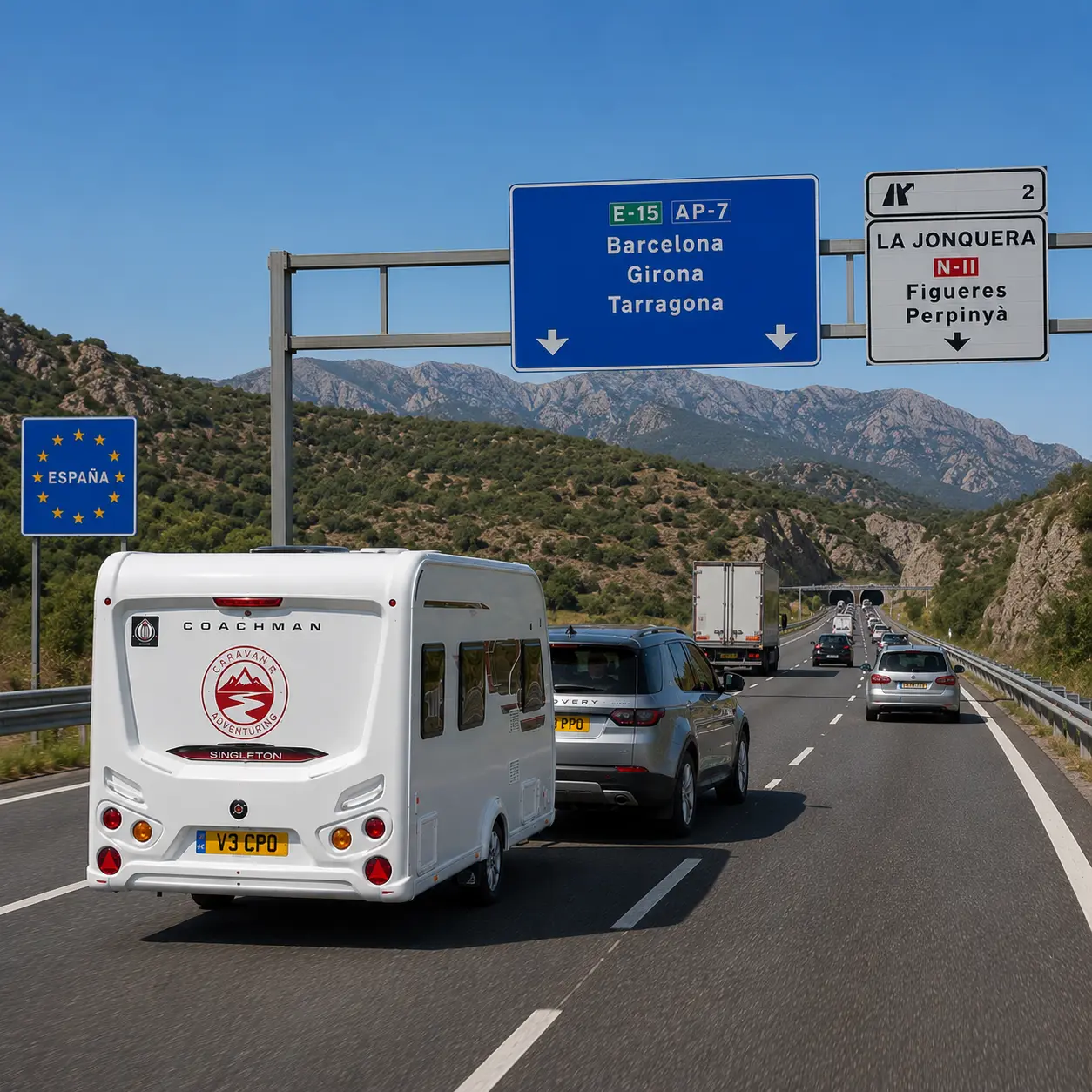
There are two main corridors from Calais towards Spain:
- The western route via Paris, Tours, Bordeaux and the Atlantic side of the Pyrenees.
- The eastern route via Reims, Dijon, Lyon, Orange, Narbonne and the Mediterranean side of the Pyrenees.
The best choice depends on your destination. The western route suits northern Spain, Madrid and parts of western or central Spain. The eastern route is normally better for the Costa Brava, Barcelona, Valencia, Alicante and much of the Mediterranean coast.
Eurotunnel to Northern Spain
Recommended route: A26, A1, A3/A86, A10 towards Bordeaux, A63 towards Bayonne and the Spanish border, followed by the AP-8 or A-8.
This route enters Spain near Irún and is the most natural option for San Sebastián, Bilbao, Santander, Asturias and much of the northern Spanish coast.
The A63 through southwest France is a major long-distance route used by large numbers of cars and commercial vehicles. It is generally suitable for caravans but can become busy around Bordeaux, Bayonne and the border.
Best for: San Sebastián, Bilbao, Santander and northern Spain.
Watch out for: Heavy freight traffic, strong winds and busy border approaches.
Suggested overnight area: Tours, Poitiers, Saintes, Bordeaux or Bayonne.
Eurotunnel to Madrid
Recommended route: Travel towards Bordeaux and Bayonne using the A10 and A63, cross into Spain near Irún and continue towards Vitoria-Gasteiz, Burgos and Madrid using major Spanish routes.
This is normally more practical than travelling through Barcelona when Madrid is your destination. The Spanish motorway network after the border is generally good, although local road classifications, toll arrangements and low-emission restrictions should be checked before travelling.
Best for: Madrid and central Spain.
Watch out for: Madrid’s low-emission and access restrictions. Do not enter the city centre with a caravan unless your route and destination have been carefully checked.
Suggested overnight area: Bordeaux, Bayonne, Burgos or a campsite outside Madrid.
Eurotunnel to Barcelona and the Costa Brava
Recommended route: A26 towards Reims and Troyes, A5 and A31 towards Dijon, A6 towards Lyon, A7 towards Orange, A9 through Montpellier and Narbonne, then the AP-7 after entering Spain.
This eastern route avoids Paris and follows major motorways almost all the way to the Spanish Mediterranean coast. It is normally the most practical route for Girona, the Costa Brava and Barcelona.
Although parts of Spain’s AP-7 corridor have become toll-free, tolls still apply on much of the French motorway section. Current Spanish toll information should be checked before departure because toll arrangements can change by road and concession.
Best for: Girona, the Costa Brava and Barcelona.
Watch out for: Barcelona low-emission restrictions, strong crosswinds, French summer traffic and congestion near the border.
Suggested overnight area: Troyes, Dijon, Mâcon, Lyon, Orange, Montpellier or Narbonne.
If your campsite is outside Barcelona, choose a route that remains on the outer motorway network. Driving through the centre with a caravan is rarely worthwhile and may take you into restricted areas.
Eurotunnel to the Costa Dorada
Recommended route: Follow the Mediterranean route through Lyon, Orange, Montpellier, Narbonne, Girona and Barcelona, then continue towards Tarragona.
This is the most logical route for Salou, Cambrils, Tarragona and the wider Costa Dorada. The road is predominantly motorway, making it suitable for long-distance towing when the journey is divided into sensible stages.
Best for: Tarragona, Salou and Cambrils.
Watch out for: Congestion around Barcelona and Tarragona.
Suggested overnight area: Orange, Montpellier, Narbonne, Girona or north of Barcelona.
Eurotunnel to Valencia
Recommended route: Travel via Reims, Dijon, Lyon, Orange, Narbonne and Barcelona before continuing south on the AP-7 and A-7 corridor towards Valencia.
This is a substantial journey and should normally be treated as a multi-day tour rather than a single drive. Three travel days may be more comfortable for many caravanners, particularly when the first day also includes driving to Folkestone from elsewhere in the UK.
Best for: Valencia and the central Mediterranean coast.
Watch out for: Low-emission restrictions around Barcelona and Valencia, plus busy motorway sections near coastal resorts.
Suggested overnight areas: Burgundy or the Rhône Valley on the first night, followed by southern France or Catalonia on the second.
Eurotunnel to Alicante, Benidorm and the Costa Blanca
Recommended route: Follow the eastern route through Lyon, Orange, Narbonne, Barcelona, Tarragona and Valencia before continuing south towards Alicante and Benidorm.
This is usually the most direct route for the Costa Blanca. A western route via Bordeaux and Madrid can sometimes be considered, but it is normally less logical for coastal destinations around Alicante unless traffic, weather or planned stops make it preferable.
Best for: Alicante, Benidorm, Calpe and the Costa Blanca.
Watch out for: Strong winds, long driving days and urban restrictions near major Spanish cities.
Suggested journey length: At least three comfortable towing days from Calais for many touring outfits.
Should You Use the Western or Eastern Route to Spain?
Use the western route via Bordeaux for:
- San Sebastián
- Bilbao
- Santander
- Burgos
- Madrid
- Northern and northwestern Spain
Use the eastern route via Lyon and Narbonne for:
- Girona
- Costa Brava
- Barcelona
- Costa Dorada
- Valencia
- Alicante
- Benidorm
For destinations between the two corridors, compare current traffic, weather and toll costs rather than relying solely on distance. A route that is slightly longer but remains on major motorways may be considerably easier with a caravan.
Best Routes from Eurotunnel to Italy
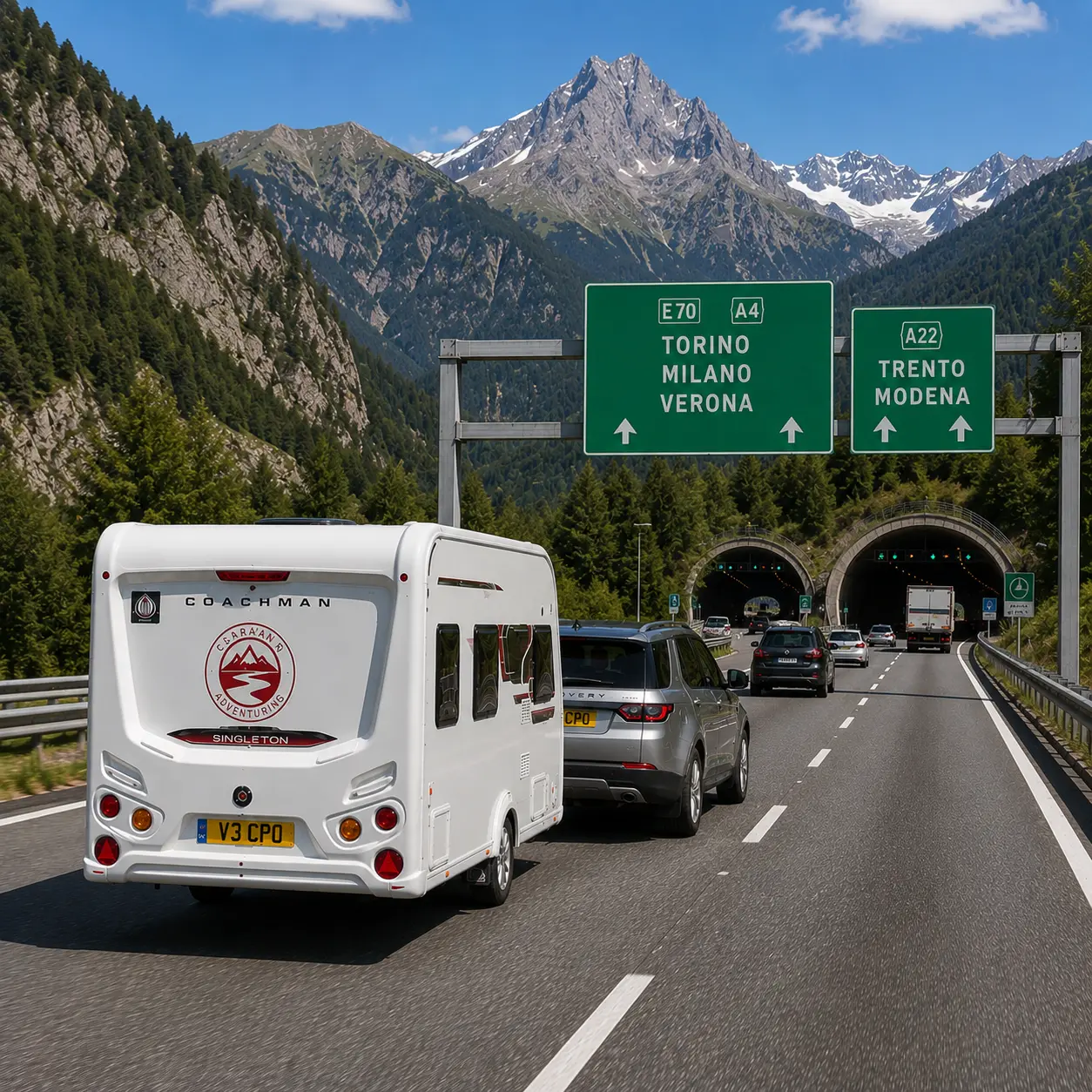
There is no single best route from Calais to Italy. The most suitable option depends on whether you are visiting northwestern Italy, the Italian Lakes, Venice, Tuscany or the Adriatic coast.
The main options are:
- Through France using the Fréjus or Mont Blanc Tunnel.
- Through France and Switzerland.
- Through Belgium, Luxembourg, Germany, Austria and the Brenner Pass.
Each route has different tolls, vignettes, tunnel charges and mountain considerations, so it is worth comparing the options carefully before deciding which one is best for your touring outfit.
Eurotunnel to Turin
Recommended route: A26 towards Reims and Troyes, A5 and A31 towards Dijon, A6 towards Lyon, A43 towards Chambéry and Modane, followed by the Fréjus Road Tunnel into Italy.
This is normally the most direct route for Turin and parts of the western Italian Alps. It remains on major roads but includes substantial French motorway tolls and a separate charge for the Fréjus Tunnel.
Best for: Turin, Susa and northwestern Italy.
Watch out for: Tunnel charges, vehicle classifications, weather and temporary restrictions.
Suggested overnight area: Troyes, Dijon, Mâcon, Lyon or Chambéry.
Check the tunnel operator’s current rules before travelling, particularly if you have a large motorhome, unusual fuel system or vehicle exceeding standard height or weight limits.
Eurotunnel to the Italian Lakes
Recommended route: Travel via Reims, Metz and Strasbourg, then continue towards Basel and cross Switzerland towards Lucerne and the Gotthard route before entering Italy near Como or Lugano.
This is a popular route for Lake Como, Lake Maggiore and Milan. Swiss motorways use a vignette system rather than conventional toll booths. A car towing a caravan normally requires one vignette for the car and a second for the caravan.
Motorhomes over the relevant Swiss weight threshold may be subject to a different road-charge system, so owners should check the rules applying to their vehicle before crossing the border.
Best for: Lake Como, Lake Maggiore, Lugano and Milan.
Watch out for: Swiss vignette requirements, queues at the Gotthard Tunnel and Alpine weather.
Alternative: Routes through France using the Mont Blanc or Fréjus Tunnel may suit some western Italian destinations.
Eurotunnel to Lake Garda
There are two main options for reaching Lake Garda from the Eurotunnel terminal.
Option One: Through Switzerland
Travel via Reims, Metz, Strasbourg, Basel and the Gotthard route, then continue through northern Italy towards Milan, Brescia and Lake Garda.
This can be convenient for the western and southern sides of the lake but may involve congestion around the Gotthard Tunnel and Milan.
Option Two: Through Germany and Austria
Travel through Belgium and Luxembourg into Germany, then continue towards Stuttgart, Munich, Innsbruck and the Brenner Pass before entering northern Italy.
This route can be particularly useful for the eastern side of Lake Garda and destinations around Verona. It requires an Austrian motorway vignette and may involve additional tolls on the Brenner route.
Best route: This depends on your chosen campsite and which side of Lake Garda you are visiting.
Watch out for: Mountain traffic, vignette requirements, separate route tolls and busy Italian motorways.
Suggested overnight area: Luxembourg, southern Germany, Alsace, Switzerland or western Austria.
Eurotunnel to Venice
Recommended route: Travel through Belgium and Luxembourg into Germany, continue towards Stuttgart and Munich, cross Austria via Innsbruck and the Brenner Pass, then follow the Italian motorway network towards Verona, Padua and Venice.
This route avoids the expensive French Alpine tunnels and is usually the most natural option for Venice and northeastern Italy. However, it still involves Austrian vignette requirements, possible additional route tolls and Italian motorway charges.
Best for: Verona, Venice and northeastern Italy.
Watch out for: Heavy traffic around Munich, Innsbruck, the Brenner corridor, Verona and Venice.
Suggested overnight area: Luxembourg, Stuttgart, Ulm, Munich or Innsbruck.
Do not attempt to drive a caravan into historic Venice. Choose a campsite or touring site on the mainland and use public transport, a shuttle service or a boat connection to visit the city.
Eurotunnel to Tuscany
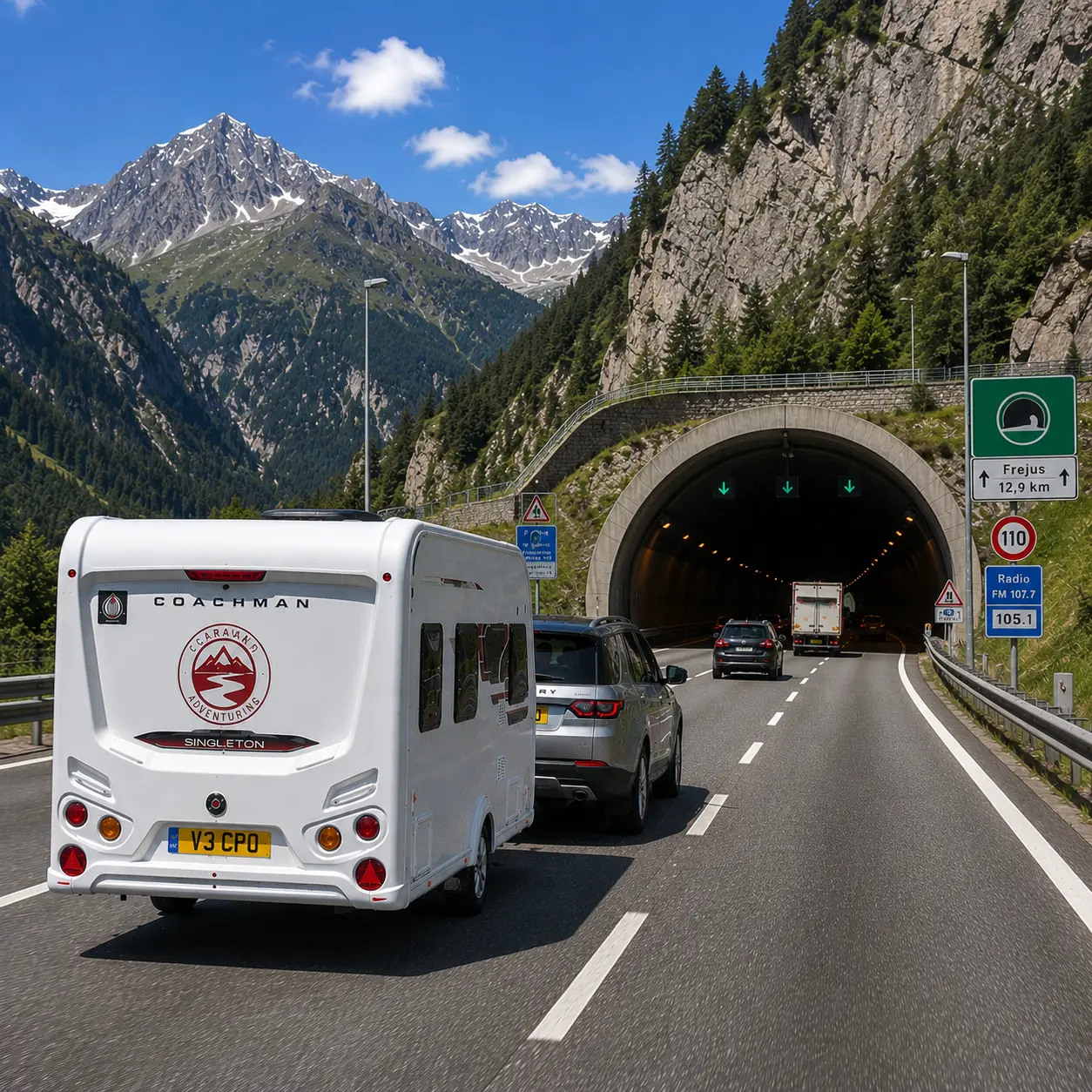
For Tuscany, the route through Switzerland is often convenient. Travel towards Basel, cross Switzerland using the Gotthard corridor and continue into Italy past Milan and Bologna before heading towards Florence.
An alternative route uses Germany, Austria and the Brenner Pass before travelling south through Verona and Bologna. The better option will depend on your starting time, planned overnight stops, current tunnel traffic and the location of your Tuscan campsite.
Best for: Florence, Pisa, Lucca, Siena and the Tuscan countryside.
Watch out for: Italian ZTL restricted traffic zones in historic towns and cities.
Suggested overnight area: Alsace, Switzerland, southern Germany, Austria or northern Italy.
Many Italian historic centres operate Zona a Traffico Limitato restrictions. Cameras can record vehicles entering without permission, and fines may arrive after the trip. Park or stay outside restricted centres and use public transport wherever possible.
Which Route to Italy Should You Choose?
Choose the Fréjus route for:
- Turin
- Western Piedmont
- Northwestern Italy
Choose the Swiss route for:
- Lake Como
- Lake Maggiore
- Milan
- Some routes towards Tuscany
Choose the Germany and Austria route for:
- Lake Garda
- Verona
- Venice
- The Dolomites
- Northeastern Italy
Do not choose an Alpine route purely because it appears shortest. Check tunnel closures, weather forecasts, towing restrictions and vignette requirements before committing to it.
Best Routes from Eurotunnel to Germany
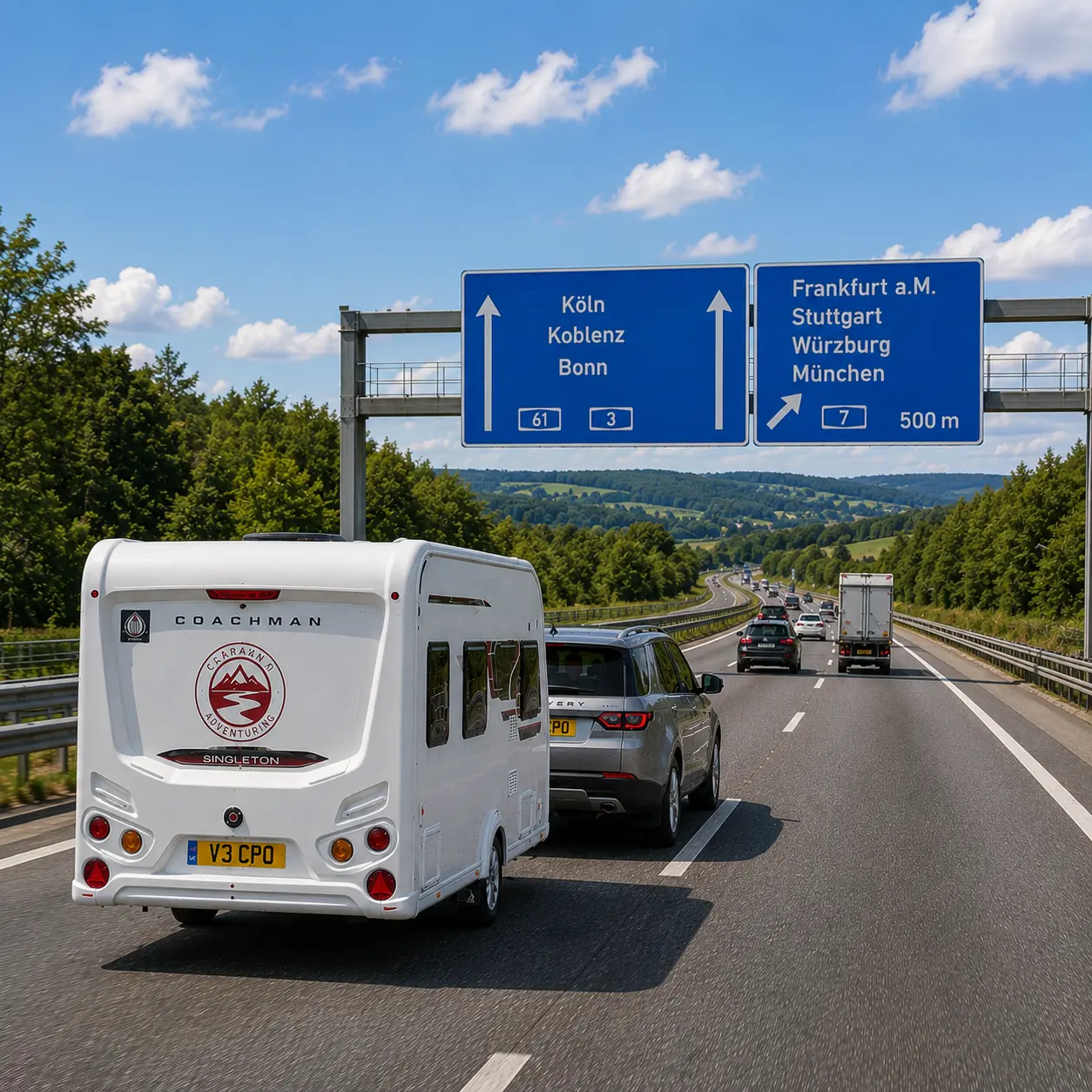
Most routes from Calais to Germany pass through Belgium, although Luxembourg and northeastern France can also form part of the journey. Belgium does not generally charge ordinary cars to use its motorway network, making it a useful corridor towards Germany.
Germany does not have a general motorway vignette for ordinary passenger cars. However, vehicles entering designated urban environmental zones may require a green Umweltplakette emissions sticker. Motorhomes and other heavier vehicles should check whether weight-based road charging rules apply to their particular vehicle and use.
Eurotunnel to Cologne
Recommended route: A16 towards Dunkirk, continue into Belgium towards Ghent or Brussels, then use the Belgian motorway network towards Liège and enter Germany towards Aachen and Cologne.
This is one of the most straightforward German journeys from Calais. The route uses major motorways and can often be completed in a single day from the Eurotunnel terminal, depending on your arrival time and towing pace.
Best for: Aachen, Cologne and onward travel into western Germany.
Watch out for: Congestion around Brussels, Liège, Aachen and Cologne.
Environmental zone: Check whether your campsite or planned city route enters a designated zone.
Eurotunnel to the Rhine Valley
Recommended route: Travel through Belgium towards Liège, Aachen and Cologne, then continue south towards Koblenz and the Rhine Valley.
This route is suitable for touring areas around Koblenz, Boppard, Rüdesheim and the Middle Rhine. The final route may vary depending on which side of the river your campsite is located.
Best for: Koblenz and the Middle Rhine.
Watch out for: Narrow riverside roads, railway crossings and busy tourist towns.
Tip: Check which side of the Rhine your campsite is on before following the final sat-nav directions.
A route that appears shorter may involve a ferry crossing or narrow riverside section. Check the final approach carefully, particularly with a long caravan.
Eurotunnel to the Black Forest
Recommended route: Travel through Belgium and Luxembourg, then continue towards Metz, Strasbourg and into Germany near Kehl or further south near the Rhine.
This route is useful for Baden-Baden, Freiburg and the western Black Forest. Depending on your exact destination, you may remain in France on the A35 for much of the southbound journey before crossing into Germany closer to your campsite.
Best for: Baden-Baden, Freiburg and the Black Forest.
Watch out for: Environmental zones, mountain roads and steep campsite approaches.
Suggested overnight area: Luxembourg, Metz, Nancy or Alsace.
Eurotunnel to Munich and Bavaria
Recommended route: Travel through Belgium and Luxembourg, continue towards Saarbrücken, Karlsruhe and Stuttgart, then follow the German motorway network towards Ulm and Munich.
This is a long but largely motorway-based journey. Germany’s autobahns can be fast-moving, and vehicles may approach from behind much more quickly than UK drivers expect. When towing, remain in the appropriate lane and allow plenty of time when overtaking slower traffic.
Best for: Stuttgart, Ulm, Munich and Bavaria.
Watch out for: Congestion around Stuttgart and Munich, particularly during weekday rush hours and holiday periods.
Suggested overnight area: Luxembourg, Saarland, Karlsruhe or Stuttgart.
Eurotunnel to Germany’s Romantic Road
For destinations such as Würzburg, Rothenburg ob der Tauber, Dinkelsbühl and Füssen, travel through Belgium and Luxembourg before continuing into Germany towards the most suitable north-south motorway for your chosen starting point.
The Romantic Road itself includes smaller roads and historic towns. It is therefore worth choosing a campsite outside each major town and exploring without the caravan attached.
Best for: Würzburg, Rothenburg ob der Tauber, Dinkelsbühl, Augsburg and Füssen.
Watch out for: Narrow historic streets and pedestrianised centres.
Tip: Use the motorway for transfers between regions rather than towing through every town on the official tourist route.
Should You Avoid Paris When Towing?
Many sat-nav systems automatically route journeys towards western and southwestern France through the Paris area. The A1, A3, A86 and A10 can be efficient when traffic is flowing, but they can also become heavily congested.
Crossing the Paris region may be reasonable when:
- You are travelling outside peak commuting periods.
- Traffic reports show that the main route is flowing normally.
- Your tow vehicle complies with applicable low-emission rules.
- You are confident driving in dense motorway traffic.
- Your destination lies directly south or southwest of Paris.
Avoiding Paris may be preferable when:
- You are towing in continental Europe for the first time.
- You are travelling during weekday rush hour.
- You have a particularly long or wide touring outfit.
- There are major delays or roadworks around the city.
- You would prefer a calmer journey even if it takes slightly longer.
Popular alternatives include travelling west through Rouen and Chartres or east through Reims, Troyes and Dijon. The eastern route is particularly useful for Burgundy, Lyon, Provence, the French Alps, eastern Spain and parts of Italy.
France operates low-emission zones known as Zones à Faibles Émissions. Requirements can change, so check your route and obtain any required Crit’Air sticker from the official French service before travelling.
Check or order a French Crit’Air sticker →
Should You Use Toll Roads or Toll-Free Routes?
French autoroutes are usually the quickest and easiest roads for long-distance towing. They normally have regular service areas, clear signs and fewer roundabouts or village restrictions than toll-free alternatives.
The disadvantage is cost. A car and caravan may be charged differently from a solo car depending on height and vehicle classification. Motorhome toll classes can also vary according to height, weight and axle configuration.
Advantages of Toll Motorways
- Faster progress over long distances.
- Fewer junctions and roundabouts.
- Regular service areas and fuel stations.
- Generally easier overtaking and lane positioning.
- Reduced risk of unsuitable village roads.
Advantages of Toll-Free Routes
- Lower overall journey cost.
- More opportunities to visit towns and rural areas.
- Potentially more scenic journeys.
- Greater access to local supermarkets and fuel stations.
Disadvantages of Avoiding Tolls
- Longer journey times.
- More roundabouts, junctions and speed changes.
- Possible narrow village roads.
- More frequent braking and acceleration.
- Fewer large rest areas suitable for caravans.
A good compromise is to use toll roads for the longest or most complicated sections and leave the motorway only when the alternative is genuinely convenient. Avoiding every toll can turn a manageable travel day into a slow and tiring journey.
Check French autoroute information →
Planning Overnight Stops
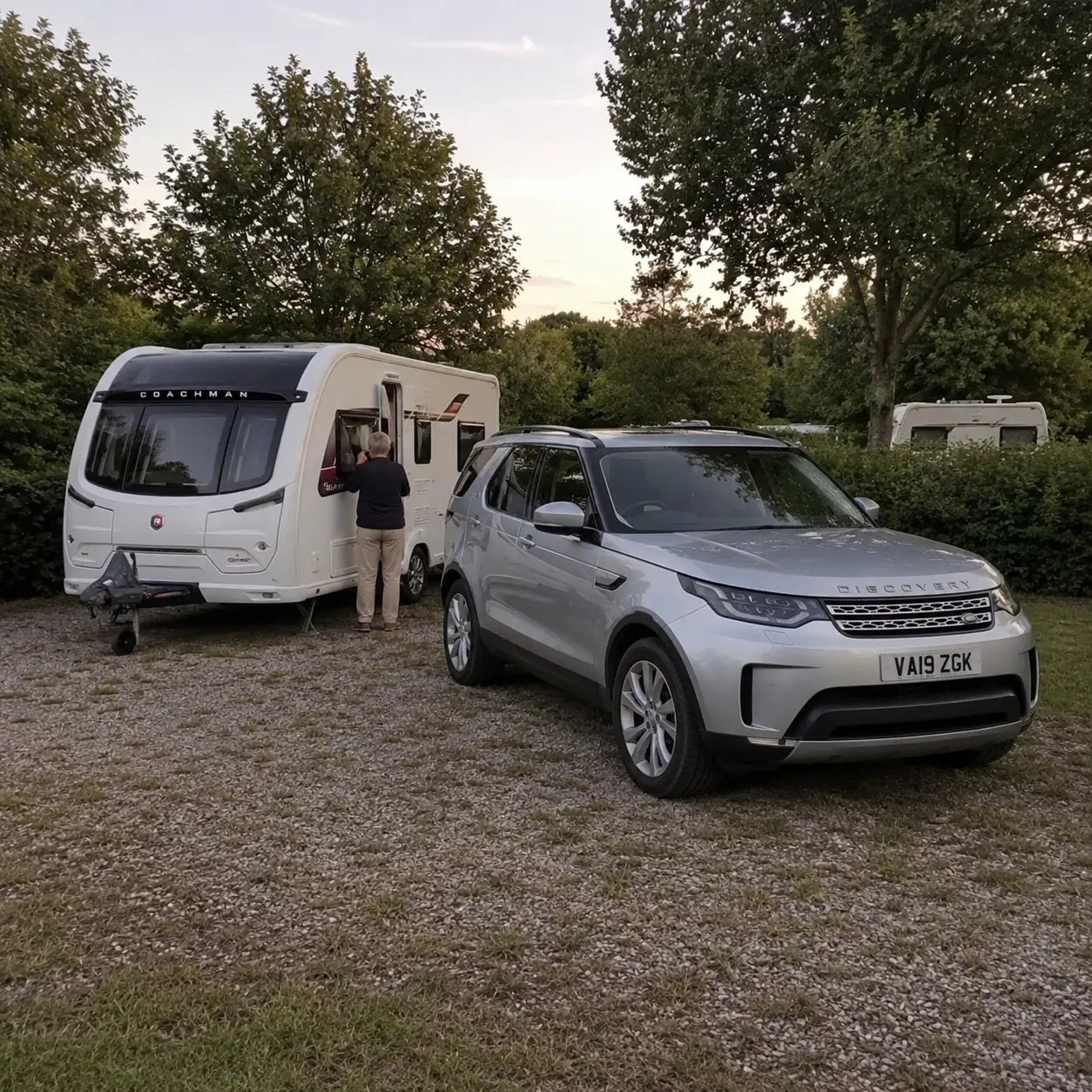
Journey times shown by online mapping services rarely account properly for towing speeds, fuel stops, rest breaks, toll booths, congestion or the time needed to reach a campsite after leaving the motorway.
A route shown as eight hours of continuous driving can easily become ten or eleven hours once sensible breaks are included. It is therefore better to plan travel days using realistic towing times rather than the fastest estimated car journey.
Good Overnight-Stop Principles
- Choose a campsite within a short distance of the main route.
- Avoid sites requiring a city-centre approach.
- Check arrival and reception-closing times.
- Confirm that late arrivals are accepted where necessary.
- Check that the pitch length is suitable without unhitching if you want an early departure.
- Allow extra time for traffic, fuel and meal breaks.
- Keep the final day shorter when the destination has narrow local roads.
Useful first-night areas from Calais can include:
- Reims for eastern and southeastern routes.
- Troyes or Langres for Burgundy, Lyon and Provence.
- Rouen or Évreux for Normandy, Brittany and Paris-avoiding western routes.
- Chartres or Orléans for the Loire Valley, Dordogne and Bordeaux.
- Belgium or Luxembourg for Germany, Austria and northeastern Italy.
The ideal stop depends on what time your Eurotunnel crossing arrives. Booking an early crossing can make it possible to travel much further into France, Belgium or Germany without creating an excessively long day.
Route-Planning Tips for Caravans and Motorhomes
Use More Than One Navigation Source
Compare your route using a caravan or motorhome sat-nav, a mainstream mapping service and written directions from your campsite. No single system is guaranteed to identify every unsuitable road or temporary restriction.
Check the Final Approach Separately
The final few miles are often more important than the motorway route. Campsites may have a recommended approach that avoids a narrow bridge, low railway arch, steep lane or difficult village turn.
Enter Your Correct Dimensions
Motorhome owners should enter the full vehicle height, width, length and weight. Caravanners should enter the complete outfit length where supported and remember that a sat-nav may not understand the caravan’s dimensions unless they are entered manually.
Download Offline Maps
Mobile coverage can disappear in rural or mountainous areas. Downloading offline maps gives you a backup if your phone loses its data connection.
Check Low-Emission Zones
France, Spain, Germany and Italy all operate different forms of low-emission or restricted traffic areas. Rules are not identical between countries and may also vary between individual cities.
- France: Check Crit’Air and local ZFE requirements.
- Spain: Check the rules for each Zona de Bajas Emisiones.
- Germany: Check whether a green Umweltplakette is required.
- Italy: Avoid unauthorised entry into ZTL restricted zones.
Check European urban access and low-emission restrictions →
Check Vignettes Before Entering Switzerland or Austria
Switzerland and Austria use motorway vignette systems. A car and caravan may require separate Swiss vignettes, while Austrian requirements and additional route tolls depend on the roads and vehicle being used.
Purchase vignettes through official services or approved outlets and check when a digital vignette becomes valid. Some online purchases may not become valid immediately because of consumer cancellation rules.
Do Not Trust Estimated Arrival Times
Add time for:
- Comfort breaks.
- Fuel stops.
- Toll queues.
- Lower towing speed limits.
- Roadworks.
- Border congestion.
- Meal breaks.
- The final campsite approach.
Avoid Major Holiday Changeover Days
French motorways can become extremely busy during summer holiday weekends, particularly the A7 through the Rhône Valley, the A9 towards Spain and routes around Paris, Lyon, Bordeaux and the Mediterranean coast.
Where possible, travel midweek or plan a shorter day during known peak periods.
Plan Fuel Stops Before You Need Them
Motorway service stations are normally easy to access, but some smaller fuel stations away from the motorway have tight entrances, low canopies or limited room to turn with a caravan.
Do not leave the motorway simply because a navigation app shows slightly cheaper fuel unless you have checked that the station is suitable for your outfit.
Consider Weather and Wind
Strong crosswinds can affect caravans and high-sided motorhomes, particularly on exposed routes in northern France, the Rhône Valley, southern France and parts of Spain.
Mountain routes can also be affected by snow, ice, high winds, tunnel closures and seasonal equipment requirements. Always check the forecast and current road conditions before committing to an Alpine crossing.
Final Thoughts
The Eurotunnel terminal at Calais provides excellent access to the French, Belgian and wider European motorway networks. From there, the best route depends on your destination, touring outfit and attitude towards tolls, city traffic and long driving days.
For western France and northern Spain, the routes through Rouen, Paris, Tours and Bordeaux are normally the most practical. For Provence, eastern Spain and parts of Italy, travelling through Reims, Troyes, Dijon and Lyon usually avoids unnecessary mileage.
Germany is generally reached through Belgium, while the best route to Italy depends heavily on whether you are heading towards Turin, the Italian Lakes, Lake Garda, Venice or Tuscany.
Whichever route you choose, divide the journey into manageable stages, check low-emission and vignette requirements and review the final campsite approach before setting off. A route that is comfortable and predictable is often a much better choice than one that saves a few miles but introduces narrow roads, city traffic or difficult mountain sections.